


MINERVINO DI LECCE: WHERE ELEGANCE HAS THE FACE OF HISTORY
June 12, 2025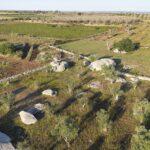
TIME BEFORE TIME, WALKING IN THE MEGALITHIC FOREST OF SALENTO
June 12, 2025MINERVINO DI LECCE: WHERE ELEGANCE HAS THE FACE OF HISTORY
June 12, 2025TIME BEFORE TIME, WALKING IN THE MEGALITHIC FOREST OF SALENTO
June 12, 2025I SEGRETI NASCOSTI DI MINERVINO DI LECCE: LEGGENDE E PASSAGGI SOTTERRANEI

Between Otranto and Maglie, there is a place that guards the Salento’s most intimate soul. Giuggianello, the smallest municipality in the province of Lecce, is a living archive of stones, rituals and essential landscapes. A town to be traversed at a slow pace, where every sign – a menhir, a wild flower, a dry stone wall – tells something of its identity.
Here are five authentic experiences to live, for those seeking the hidden heart of the territory.
1. Walking among the megaliths of the sacred forest
Between Giuggianello and Minervino di Lecce lies an extraordinary territory, marked by dolmens, menhirs and sacred rocks. Not an archaeological park in the traditional sense, but a diffuse megalithic landscape in which stone coexists with olive trees, wild thyme and wind.
Mediterranean scrub clusters around the megaliths. Carob trees bend in the wind, fig trees intertwine with the dry stone walls, wild thyme perfumes the air. Some monuments stand out like stone beacons, others are revealed among the grasses. Walking among these signs is a gesture of listening, of respect. It is a megalithic forest, because one enters on tiptoe, one remains silent, one comes out different. There is no map to follow, only an invitation to get lost with respect. And perhaps, among stones, light and wind, to find oneself.
2. Experiencing a ritual between earth and sky: St John’s Night
Every 24 June, at dawn, the hill that houses the Crypt of St John comes alive with an ancient, collective gesture. The women of the village, together with onlookers and devotees, gather herbs and flowers bathed in the dew of the night.
It is a practice linked to the auspicious rites of St John’s Day: plants are said to absorb purifying and protective virtues on that night. The perfumed water, obtained by leaving the herbs under the stars, is used in the morning to wash the face and body.
A simple yet powerful gesture that combines nature, seasonal cycles and a desire for wellbeing. And that in Giuggianello is renewed every year, amid rising light and shared silences.
3. Entering the belly of the earth at the Oil Museum
A few steps from the central square, fifteen steps lead to an underground world: the MIO – Museo Ipogeo dell’Olio. Housed in an 18th-century oil mill, carved out of the living stone, it tells the story of one of the oldest and most distinctive trades in Salento.
The millstones, the presses, the harvest tanks and the ‘sciave’ for storing the oil are still there, silent but eloquent. Visiting this place is like entering the heart of the land and the memory of work. An experience that restores dignity to the daily gesture and reveals why, in these parts, oil has always been called gold.
4. Walking the paths of ‘La Cutura
On the outskirts of the village, on once stony ground, La Cutura has transformed stone into landscape and landscape into garden. Today, it is one of the most impressive botanical gardens in southern Italy, home to exotic plants, tropical greenhouses, monumental cacti and Mediterranean essences.
Among juniper, myrtle, arbutus, lavender and centuries-old olive trees, every path is an invitation to wonder. But La Cutura is not just beauty: it is an open-air laboratory, where biodiversity is preserved as a precious asset.
An experience suitable for all seasons, which speaks of care, vision and harmony.
5. Tiptoeing into Palazzo Lubelli
In the heart of the town stands Palazzo Lubelli, now home to the Museo Civico. The building has a stratified history: born as a 16th-century tower-house, it was transformed over the centuries into a fortified masseria – the so-called ‘Masseria Castello’ – and then housed a tobacco factory. Today it welcomes the community in a new guise: it houses a permanent exhibition on rural civilisation, an archaeological section, a library and an ‘archaeo hub’ in collaboration with the University of Salento.
Here the past is not exhibited, but experienced. Palazzo Lubelli is a space for research and restitution, where memory meets the future.
Giuggianello is an invitation to slow down
Small in numbers, big in its cultural and scenic richness, Giuggianello offers authentic, true, profound experiences. Just a few minutes from Otranto, Maglie and Castro, it is a stop worth the diversions: for those who want to walk, listen, observe.
A place that you do not just walk through: you discover, you breathe, you remember.